





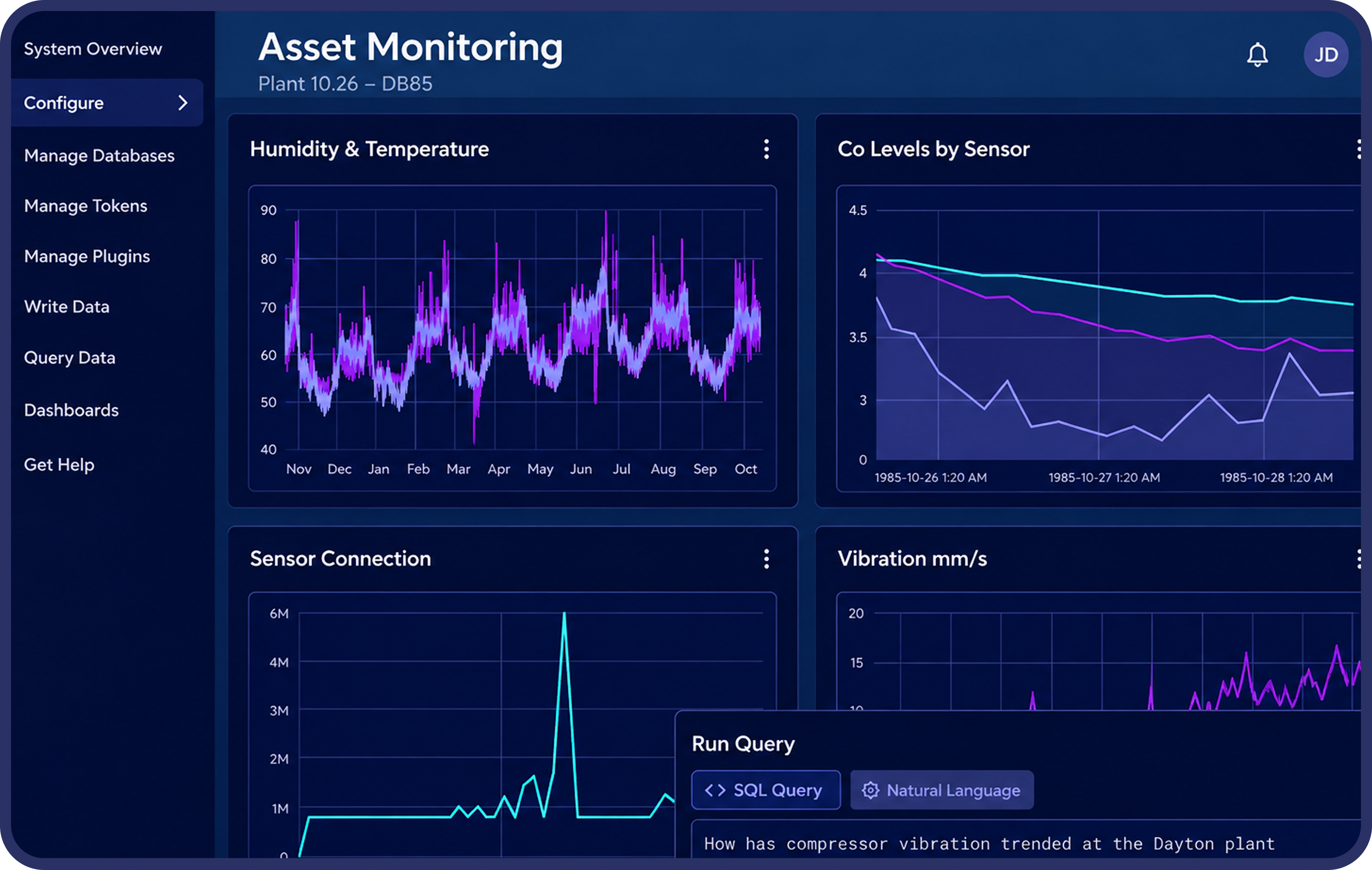
InfluxDB Data Exploration and Querying Platform Powered by AI
A modern data exploration platform that helps users navigate databases, analyze time-series data, and generate queries with AI

60% faster query creation
Average time to create and refine a query decreased from 5 minutes to 2 minutes with Claude-powered natural-language-to-SQL.
90% faster first-query generation
Users could generate an initial SQL query in about 30 seconds instead of 5 minutes using natural-language input.
50% fewer manual query steps
Claude-powered querying reduced the number of manual steps required to move from a data question to an executable SQL query by around half.
About the project
InfluxData, a leading time-series database developer reached out to Yellow for assistance. They asked us to develop InfluxDB 3 Explorer - a platform that would simplify database navigation, querying, visualization, and access management while introducing AI-powered natural-language querying.
The client had
Time-series database with API and CLI access
SQL and InfluxQL querying
Limited usability for non-CLI users
No unified visual management layer
Evolving InfluxDB 3 architecture
We were responsible for
Developing the InfluxDB 3 Explorer web UI
Creating basic query execution workflows for SQL and InfluxQL, as well as AI-powered query execution (from natural language to SQL)
Building database browsing and visualization capabilities
Implementing authentication and token management functionality
Supporting the integration of the UI into the core database product
Team
Project manager
Two AI engineers
AI-powered InfluxDB 3 Explorer
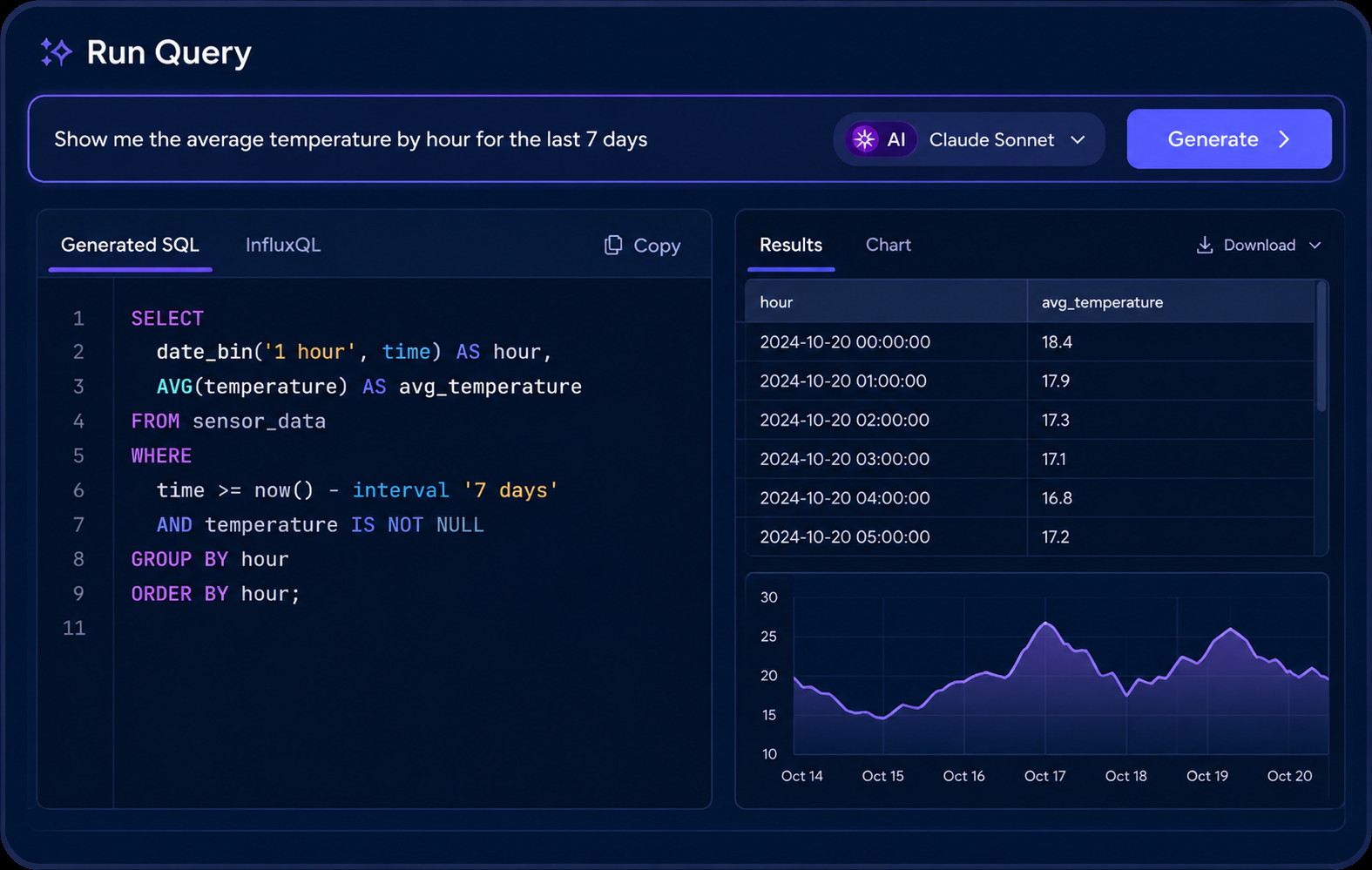
We built an AI-powered InfluxDB 3 Explorer using Claude Sonnet via the Claude API to turn natural-language requests into SQL queries. Claude was a strong fit because it can interpret complex natural-language requests, reason over database schemas, and generate accurate SQL with consistent instruction following. Its API also made it straightforward to integrate AI-powered querying directly into InfluxDB 3 Explorer. The solution simplified data exploration and query creation while contributing to 30–40% faster development cycles.
Development process
Design the exploration workflows
We mapped database browsing, query execution, visualization, and access-management flows for InfluxDB 3.
Build the core platform
We developed SQL and InfluxQL querying, database navigation, visualizations, authentication, and token management.
Add Claude-powered querying
We integrated Claude Sonnet via the Claude API to convert natural-language requests into SQL queries.
Tech stack
React
TypeScript
Rust
InfluxDB
Docker
GitHub
Claude
Cursor
Development challenges and solutions
Challenges we faced during the development process.
Integrating the UI into the core database server
Challenge: The long-term vision required the web interface to become part of the database product itself rather than remain a separate application.
Solution: We implemented a phased integration strategy that gradually embedded backend functionality and UI assets into the server architecture.

Simplifying Database Exploration
Challenge: Users needed a simpler way to work with InfluxDB 3 without relying on manually written SQL or command-line tools.
Solution: We built intuitive workflows for database browsing, query execution, and visualization.

AI-Powered Query Generation
Challenge: Natural-language requests had to be reliably converted into usable SQL queries.
Solution: We integrated Claude Sonnet via the Claude API to interpret user intent and generate SQL.

Secure Access Management
Challenge: The platform required secure access to databases and controlled credential management.
Solution: We implemented authentication and token management for secure access to InfluxDB 3.

Result
We delivered InfluxDB 3 Explorer as a unified platform for browsing databases, running SQL and InfluxQL queries, visualizing results, and managing secure access. Claude Sonnet added natural-language-to-SQL querying, making data exploration faster and easier while contributing to 30–40% faster development cycles. Development continues as the platform moves toward deeper server integration, enhanced authentication capabilities, and a unified deployment experience.

monthly cost.