- AI Transformation
- Services
- Works
Other projects
AI Learning PersonalizationSmart content recommendationsHotel AI ConciergeAI assistant for hotel guestsClaims Documentation AutomationPlatform for faster claims processingAI for Candidate ScreeningSmart HR efficiency boosterAI Voice AgentAI agent for hands-free learningLLM Legal SummarizationEfficient and fast legal summariesVision-Based Driving AssistanceReal-time threat detection system - Company
Yellow in Numbers
$2.1B+
Value generated through AI innovation47
Custom LLMs and AI agents deployed30M+
Engaging with products we created98%
Projects delivered within agreed budget



Key Facts
LangChain: The Swiss Army knife of artificial intelligence development. This framework is well-suited for building general-purpose LLM applications, but can feel a bit "low-level" when building autonomous agents compared to newer frameworks.
AutoGen: Microsoft's powerhouse for multi-agent collaboration. It excels at conversational patterns where agents talk to each other to deal with code execution and engineering tasks.
CrewAI: The new kid on the block that focuses on role-playing. It is built on top of LangChain but makes it easier for business logic to create a "crew" of agents with individual roles and goals.
The shift: We are moving from single-turn chat interfaces to "agentic workflows" where systems plan, execute, and iterate.
Complexity: These frameworks do facilitate the development, but debugging a system where three different AI agents argue with each other is a new kind of headache entirely.
It feels like every week, there is a new "breakthrough" framework that promises to “change everything” about the ways we build AI. It’s exhausting. But if you look past the noise, something actually interesting is happening in the world of AI-powered agents. We aren't just asking LLMs to write poems anymore. We are asking them to do our jobs.
For engineers and technical leaders, the challenge isn't just "how do I get an LLM to do what I want it to do?" It's "how do I coordinate a bunch of them to actually get something done without hallucinating into oblivion?" This is where agent frameworks come in. These tools are the engines that turn an intelligence model into a functional worker.
Currently, three names dominate this conversation: LangChain, AutoGen, and CrewAI. They all promise to help you build agentic systems, but they do it in vastly different ways.
Ready to build a digital workforce?
What are AI Agents and How Do They Work?
Before we start talking about anything frameworks-related, we need to agree on what an agent actually is.
So, AI agents are systems that can perceive their environment, “think” about how to achieve a goal, and use tools to actually, well, act. Unlike a chatbot that just talks, an agent does.
Think of a usual LLM as a brain in a jar. It’s brilliant, but it has no hands. An agent is that same brain connected to a body with hands (things like APIs, web search, and/or code execution) and a nervous system (the framework) that lets it coordinate those hands.
The workflow usually looks something like this:

Perception: The agent receives a task. For example, "analyze the market valuation of Apple vs. Microsoft for the last week."
Planning: It separates this into smaller parts. "I need to find market data for MSFT and AAPL. Then I’ll compare them. Then I’ll write a summary."
Execution: It uses a tool (a Python script/a search API) to get the data.
Reflection: It looks at the data. "Did I get what I needed? Yes. Now, onto the next step."
This loop—Plan, Execute, Reflect—is the heartbeat of autonomous agents.
Why Use AI Agent Frameworks?
Knowing all this, you might be thinking, "Can't I just write a Python loop that connects with the OpenAI API?"
Sure, you can. And for something simple, you probably should. But things get disarranged really fast.
When you start building complex AI workflows, you run into problems that raw API calls don't solve. How do you handle an agent that gets stuck in a loop? How do you keep the memory of a three-day-long conversation under control? How do you let two agents talk to each other without them losing the plot?
Frameworks give the abstractions for this. They handle the orchestration, memory management, and tools so you don't have to reinvent the wheel every time you want an agent to send an email. They act as the operating system for your agents.
AI Agent Use Cases
It’s easy to get swept up by the title wave of “AI agent replaces 10 jobs!” clickbait, but in the trenches, the value is more subtle. It’s more about amplifying unique human know-how than erasing people from workflows.
So, where are frameworks like LangChain, AutoGen, and CrewAI actually delivering value today?

Code generation/engineering: Engineers unleash AutoGen and LangChain-powered “assistants” to write, review, and even run code in sandboxes. Teams use agents to triage bug reports, generate tests, and propose fixes. Yes, sometimes they hallucinate entire solutions out of existence, but the speed boost for mundane coding is hard to ignore.
Knowledge management and research: CrewAI and LangChain agents ingest PDFs, scrape sites, get structured data, and generate summaries. They get research synthesis done at a fraction of the cost (and patience).
Customer support and helpdesks: Agent swarms handle ticket intake, initial triage, document fetches, and even refund workflows. CrewAI especially shines here by mapping agents’ roles to business logic, so support work becomes a cooperative relay.
Back-office automation: From HR to procurement, agents coordinate document approvals, update spreadsheets, and match data between SaaS tools with minimal human nudging.
Personal productivity: Schedule planning, calendar negotiations, email sorting, and even writing first drafts for executives now happen “in the stack.” Agents can communicate with email APIs, fill in CRMs, and send updates quietly, unless something weird happens.
The headline: Effective agents disappear into your daily processes. When they’re based on solid frameworks, they’re felt in time saved.
AI Agent Framework Assessment Metrics
When comparing AutoGen, LangChain, and CrewAI, we need to look at a few dimensions, not just which one has the most GitHub stars.
Convenience: How quickly can I go from first setup to a working agent? Is the documentation a labyrinth or a map?
Flexibility/customizability: Can I swap out the model? Can I build tailor-made tools easily? Or am I locked into the framework's way of thinking?
Multi-agent collaboration: How well does it handle multiple agents talking to each other?
Reliability and control: Do the agents go off the rails? How hard is it to debug when they do?
Community and ecosystem: Does it have enough examples out there when I inevitably get stuck?
Picking a framework is about tradeoffs. You’ll trade ultimate flexibility for speed, or guardrails for autonomy, but you’ll always want community, docs, and battle-tested design above flash.
LangChain vs AutoGen vs CrewAI: Comparison
This is the meat of the discussion. All three frameworks have distinct philosophies, and we need to consider them when choosing one.
LangChain
LangChain is the original toolbox. It burst onto the scene just as ChatGPT was taking off, and it quickly became the default standard for building anything with LLMs.

LangChain is a library of building blocks. It gives you chains, agents, memory, and tools, and says, "Build whatever you want." It is incredibly low-level and flexible. You want to build a RAG pipeline? LangChain. You want a chatbot? LangChain. You want an agent? LangChain.
For agents specifically, LangChain provides the AgentExecutor class. It works, but defining custom behaviors or complex multi-agent interactions often feels like you are fighting the framework. This feature wasn't built specifically for multi-agent systems from day one, but was added later on.
Pros:
Huge library of integrations and architectures
Deep community support (that you’ll need)
Built-in observation tools (LangSmith) for debugging
Cons:
Sharp learning curve, with documentation that often runs to “here be dragons”
Multi-agent support isn’t fully first-class and requires extra tooling
Too much for simple projects, which can result in bloated, overengineered stacks
Best for: Engineers who want control over each and every step of the process and are building complex, custom applications that go beyond just "agents talking."
AutoGen
AutoGen, developed by Microsoft, took a different approach. It looked at the disarray of LLM development and said, "What if everything was just a conversation?"
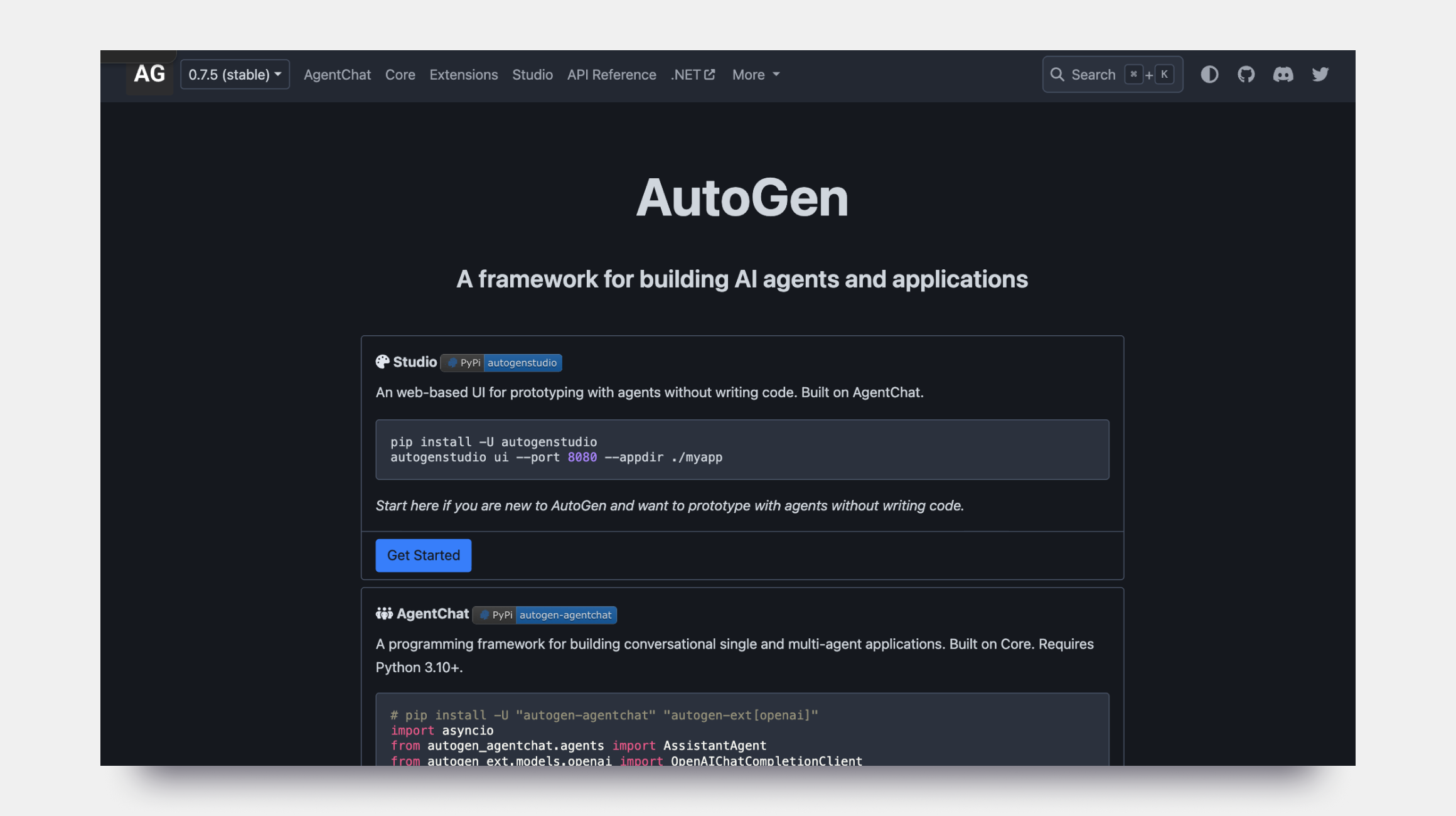
In AutoGen, everything is an "agent" that can send and receive messages. A user is an agent. A model is an agent. A code executor is an agent. To build a system, you just define these agents and let them chat. This "conversational programming" approach is outstanding. It makes multi-agent collaboration a default, not an advanced feature.
AutoGen is great for coding assignments. Its ability to have one agent write code and another agent execute it in a Docker container is seamless. It feels very "engineer-focused."
However, controlling the conversation flow can be tricky. You often end up with agents getting into infinite "thank you" loops or arguing about who should terminate the conversation. A lot of well-built prompt engineering will help keep the agents on track.
Pros:
Native support for multi-agent, many-to-many conversations
Excellent for technical, engineering, and R&D use cases
Built-in safety features for sandboxed code execution
Cons:
“Conversational” means less structure and a higher risk of never-ending dialogues/off-topic wanderings
Sparse front-end, primarily built for backend or console workflows
Documentation veers academic, sometimes lacking real-world context
Best for: Technical workflows, code generation, and intricate problem-solving where you need a "virtual team" of engineers and critics to iterate on a solution.
Looking for transparent and high-quality development?
CrewAI
CrewAI is the newcomer that looked at AutoGen and LangChain and said, "This is all too complicated.”
CrewAI is built on top of LangChain, but it hides all the ugly parts. It introduces a high-level abstraction based on role-playing. You define a "Crew" consisting of "Agents," and you assign them "Tasks."

It forces you to think in terms of structure:
Role: Senior Researcher
Goal: Uncover the latest artificial intelligence trends.
Backstory: You are a veteran tech analyst...
Because it’s built on LangChain, you get access to all the LangChain tools, which is a huge plus. But unlike raw LangChain, you don't have to wire up the AgentExecutor yourself.
The downside is that it can feel a bit rigid. If the workflow you built doesn't fit neatly into "Agent A does Task 1, then Agent B does Task 2," you might find yourself fighting the abstraction.
Pros:
Fast to start, shallow learning curve, lots of “just works” moments
Task, role, and goal assignment copies the way real teams operate
LangChain compatibility for tools, RAG, and DB connections
Cons:
Rigid process structures sometimes restrict experimental use cases
Ecosystem is new, so support and examples lag behind LangChain
Unstructured agent swarms are awkward (CrewAI is made for defined teams)
Best for: Business logic, content creation pipelines, and clear-cut processes where you can clearly outline roles and deliverables.
Final Comparison Table
| Criterion | LangChain | AutoGen | CrewAI |
|---|---|---|---|
| Core concept | Chains and tools | Conversational agents | Role-playing crews |
| Learning curve | High (steep) | Medium | Low (approachable) |
| Multi-agent | Possible (via LangGraph) | Native/excellent | Native/good |
| Code execution | Good | Excellent | Good (via Tools) |
| Best use case | Complex, custom apps | Coding/engineering | Structured business processes |
| Control | Granular (low-level) | Conversational | Process-driven |
Real-World Power and Limitations
Enough with theories. Yes, agent frameworks are mighty, disruptive—and a handful. They promise another level of productivity, but the potholes are real.
Debugging agents is not trivial: It’s one thing to look through logs for a web server. It’s another to parse why three agents (each having their own plan) decided to triangulate a single customer query until the system ran out of memory. Logging everything, tracing context, and preparing rollback plans in advance isn’t optional.
Guardrails over genius: There’s a dark art to permissioning. Every framework can accidentally generate a “paperclip maximizer.” More than once, agents have blitzed through internal APIs or shown meetings that were never meant to exist. Build with the assumption you’ll need escalation routes and emergency switches.
The integration treadmill: New vector DB? New foundation model? Shifting business requirements? The frameworks let you swap tools, but friction remains. Tech debt can accrue quickly if you’re not vigilant about maintenance and review.
Illusions of simplicity: There are things that look elegant on a whiteboard (five agents, five roles, five tasks), but become gnarly when getting to production, especially as requirements change, or agents start “thinking” for themselves by generating or ingesting content you didn’t explicitly plan for.
Best Practices for Building With Agentic AI Frameworks
Ready to build? Sharpen these habits before letting your agents run wild:
Start small and observable: Build one agent for one task. Get logs working first. Add more only after you trust the flow and outputs.
Monitor everything (twice): The logs aren’t just for audits. Use tracing for every agent step, especially for financial data, permissions, or real-world actions.
Rule-based prompts/constraints: Don’t just send “be helpful!” as a prompt. Clear roles and strict instructions keep agents from wandering off-track.
Test adversarially: Try to break your own agents. Ask crazy questions, force tool mismatches, yank network connections. The edge cases matter.
Embrace the community: Read new releases, learn from bugs others share, and write your own stories. The frameworks move fast, and group wisdom is gold.
Your endurance will pay off: Agentic workflows built with discipline often become the “secret sauce” of modern digital workflows.
The Future of Agentic AI
So, where is this all going?
Right now, we are getting into a turbulent phase. These frameworks are changing rapidly. LangChain is trying to become more agentic with LangGraph. AutoGen is trying to become more controllable. CrewAI is adding more elaborate routing capabilities.
There is a clear trend toward hybrid architectures. We are seeing engineers use LangChain to build customized tools, wrap them in a CrewAI agent for the high-level logic, and maybe even use an AutoGen sub-group for a coding task.
Another massive trend is observability. It’s terrifying to let an autonomous agent loose on your database. Tools that allow us to trace, monitor, and watch over whatever agents do are going to become just as important as the frameworks themselves. We need to know why the agent decided to delete that file, not just that it did.
Finally, we are going to see a shift from "generalist" agents to highly specialized, fine-tuned agent models. Instead of using GPT-4 for everything, frameworks will orchestrate a swarm of smaller, cheaper, specialized models—one for coding, one for writing, one for data queries.
Final words
Choosing between AutoGen vs LangChain vs CrewAI isn't about finding the "best" framework. It's about matching the tool to your mindset and your problem.
If you are a software engineer who wants to build a strong, custom architecture and you don't mind getting your hands dirty with the plumbing, stick with LangChain (and LangGraph).
If you plan on simulating a team of engineers solving a hard technical problem through dialogue and coding, AutoGen is your best bet.
If you are focused on business process automation and want to spin up a virtual workforce quickly with obvious roles/responsibilities, CrewAI is the way to go.
Have a vision for a custom AI platform? We’ll help you build it!
The most important thing is just to start building. The "perfect" framework doesn't exist yet, but the capabilities we have right now are already enough to build things that were impossible two years ago.
Got a project in mind?
Fill in this form or send us an e-mail
Can I mix the frameworks in one project?
Which framework is best for a beginner?
Do these frameworks work with local LLMs?
Subscribe to new posts.
Get weekly updates on the newest design stories, case studies and tips right in your mailbox.